Monitor Home Energy Consumption: Top Tips & Tools
Let’s be honest, opening your utility bill often feels like a lottery you didn’t choose to play. The numbers jump up, they dip down, but the why behind it all remains a frustrating mystery. If you've ever felt that lack of control, you'll understand why home energy monitoring is becoming a must-have for any modern homeowner.
If you really want to monitor home energy consumption, you need something that translates confusing utility data into clear, actionable insights. Modern software can now sync directly with your smart meter, showing you exactly where your money is going without needing any complicated hardware.
Why You Need to Monitor Your Home Energy Use
This isn't just about a vague desire to "save money." Actively monitoring your energy use gives you the power to tackle real-world challenges head-on. With energy costs on the rise, getting a grip on your consumption patterns is a financial necessity.
It’s about making the switch from being a passive bill-payer to an active, informed energy manager for your own home.
Gain True Command Over Your Home
The real power of monitoring comes from visibility. Instead of getting one cryptic number on a bill each month, you get a detailed, day-by-day (or even hour-by-hour) breakdown of your household's energy habits.
This clarity helps you:
- Hunt Down "Energy Vampires": Pinpoint which devices are secretly draining power even when you think they're off.
- Optimize Your Smart Home: See the actual dollar impact of your smart thermostat, lighting schedules, and EV charging times.
- Track Your Environmental Impact: Make real, measurable cuts to your carbon footprint by finding and eliminating waste.
By turning abstract data into a clear story, you can finally see exactly where every kilowatt-hour—and every dollar—is going. This insight is the first step toward meaningful savings and a more efficient home.
This shift toward proactive energy management isn't just a personal trend; it's a global movement. The home energy management system (HEMS) market, valued at USD 3.76 billion, is projected to explode to around USD 14 billion by 2033. That's a growth rate of about 15.7% annually.
This boom, detailed in the full home energy management market projections on renub.com, shows a worldwide demand for greater control over household expenses and environmental impact.
Ultimately, to monitor your home energy consumption is to take back control. It’s about making smarter decisions that benefit your wallet and the planet, giving you the command over your home you deserve.
Choosing the Right Home Energy Monitoring Tool
Figuring out the best way to monitor home energy consumption can seem like a huge task, but it really just boils down to a few key choices. The market is full of different tools, and each comes with its own price tag, setup process, and level of detail. What’s right for you really depends on your budget, how tech-savvy you are, and what you’re trying to accomplish.
You don't need to be an electrician to get started. The options range from simple software that connects to your utility data to smart plugs that just track one gadget at a time. Picking your path is the most important first step.
Hardware vs. Software Monitors
The first big decision is whether you want a physical device or a software-based service.
Hardware monitors, like the clamp-on systems you see, attach directly to your home’s electrical panel. They give you incredibly granular, real-time data, often breaking down usage circuit by circuit.
The catch? They come with a higher upfront cost, usually between $150 to over $300. Plus, the installation can be tricky. While some DIY-ers can handle it, many people (and I'd probably be one of them) would rather hire an electrician for safety, which adds to the overall cost.
Then you have software platforms like Youtilitics. This is a totally different approach that requires zero hardware installation. Instead, these services securely connect to the smart meter your utility provider already has on your home, pulling the data they're already collecting. This makes setup a breeze—it usually just takes a few minutes on your computer.
Appliance-Specific vs. Whole-Home Tracking
Next, you need to think about scope. Are you trying to see the big picture of your home’s energy use, or are you hunting for one specific energy hog?
- Smart Plugs: These are perfect for targeted investigations. If you've got a hunch that your old desktop computer or the living room entertainment center is an "energy vampire," a smart plug is the way to prove it. They’re cheap and give you exact data for a single appliance.
- Whole-Home Systems: For a complete overview, you need a solution that sees everything. This is where those hardware panel monitors and software services really come into play, giving you a full picture of your daily, weekly, and monthly energy habits.
This decision tree gives a great visual of how your goals point you toward the right tool.
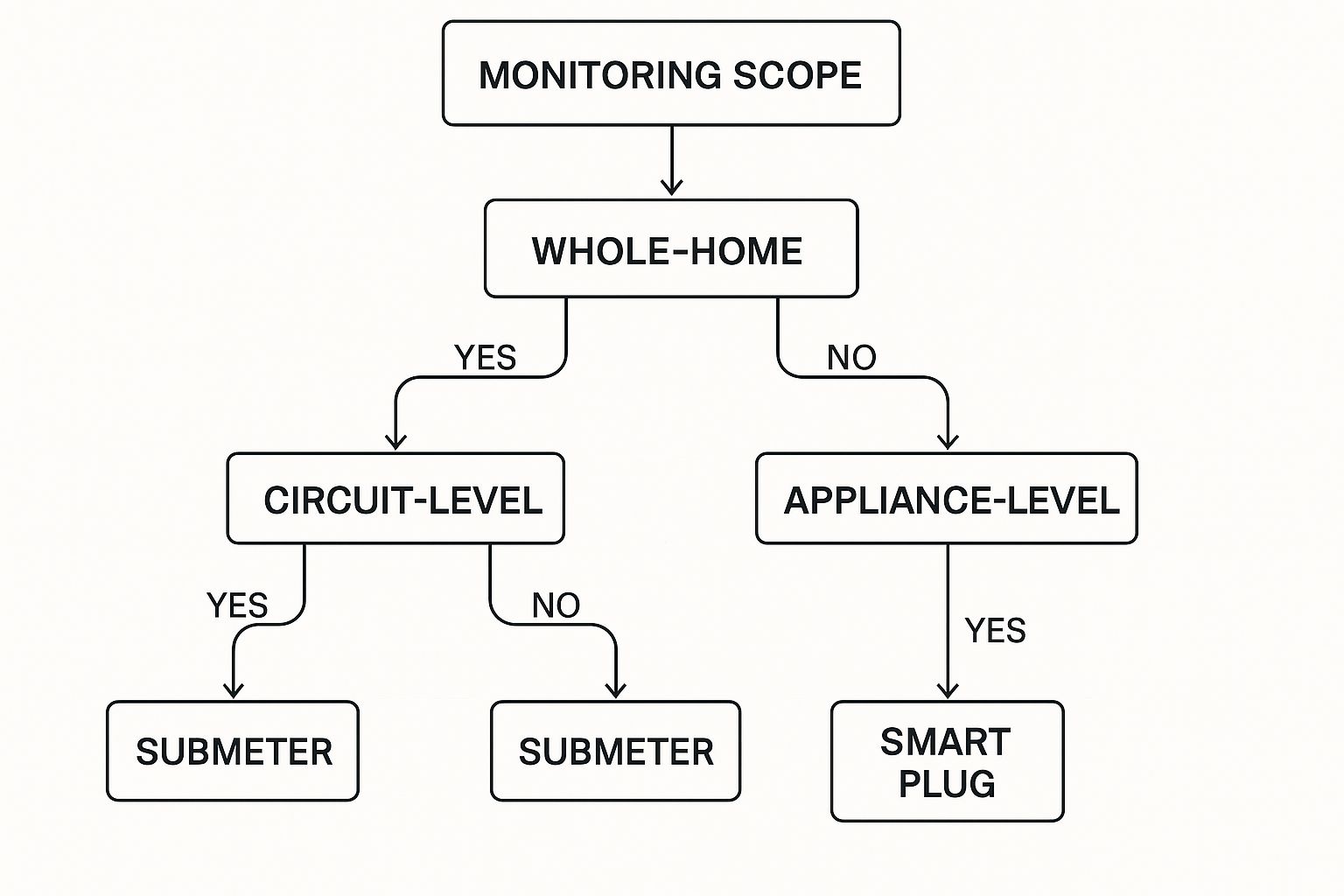
As you can see, it's pretty straightforward: if you just need to check on a single device, a smart plug is your best bet. But for the broader insights that lead to bigger savings, you’ll want to look at smart meter software or circuit-level hardware.
To help you decide, let's break down the most common options side-by-side.
Comparing Home Energy Monitoring Methods
This table breaks down the key differences between the most common types of home energy monitors to help you choose the best fit for your needs.
| Monitoring Method | Best For | Installation | Cost | Data Granularity |
|---|---|---|---|---|
| Smart Meter Software | Easy, whole-home monitoring for most homeowners. | Software setup in minutes. No physical install. | Free or low-cost subscription. | Whole-home usage (hourly/daily). |
| Circuit-Level Hardware | Detailed analysis for tech-savvy users or electricians. | Requires opening electrical panel. Professional recommended. | $150 - $300+ | Real-time, per-circuit data. |
| Smart Plugs | Tracking a single, specific appliance. | Plug into an outlet. Simple. | $10 - $30 per plug. | Real-time data for one device. |
Ultimately, each method has its place depending on what you're trying to figure out about your home's energy use.
Making the Right Choice for You
At the end of the day, the best tool is the one you'll actually stick with.
For homeowners who want every last bit of data and don't mind a more involved setup, a hardware monitor is a powerful choice. It delivers those circuit-level insights that can tell you exactly which breaker is pulling the most power.
For most people, however, the simplicity and accessibility of a software platform offer the best balance. There’s no upfront hardware cost, no installation anxiety, and you can start seeing valuable data within hours.
This software-first approach really opens up energy monitoring to everyone. As long as you have a smart meter and an internet connection, you're good to go. By syncing directly with your utility, these platforms give you accurate, whole-home data without the cost and headache of traditional hardware, letting you find savings opportunities almost immediately.
Setting Up Your Youtilitics Energy Monitor
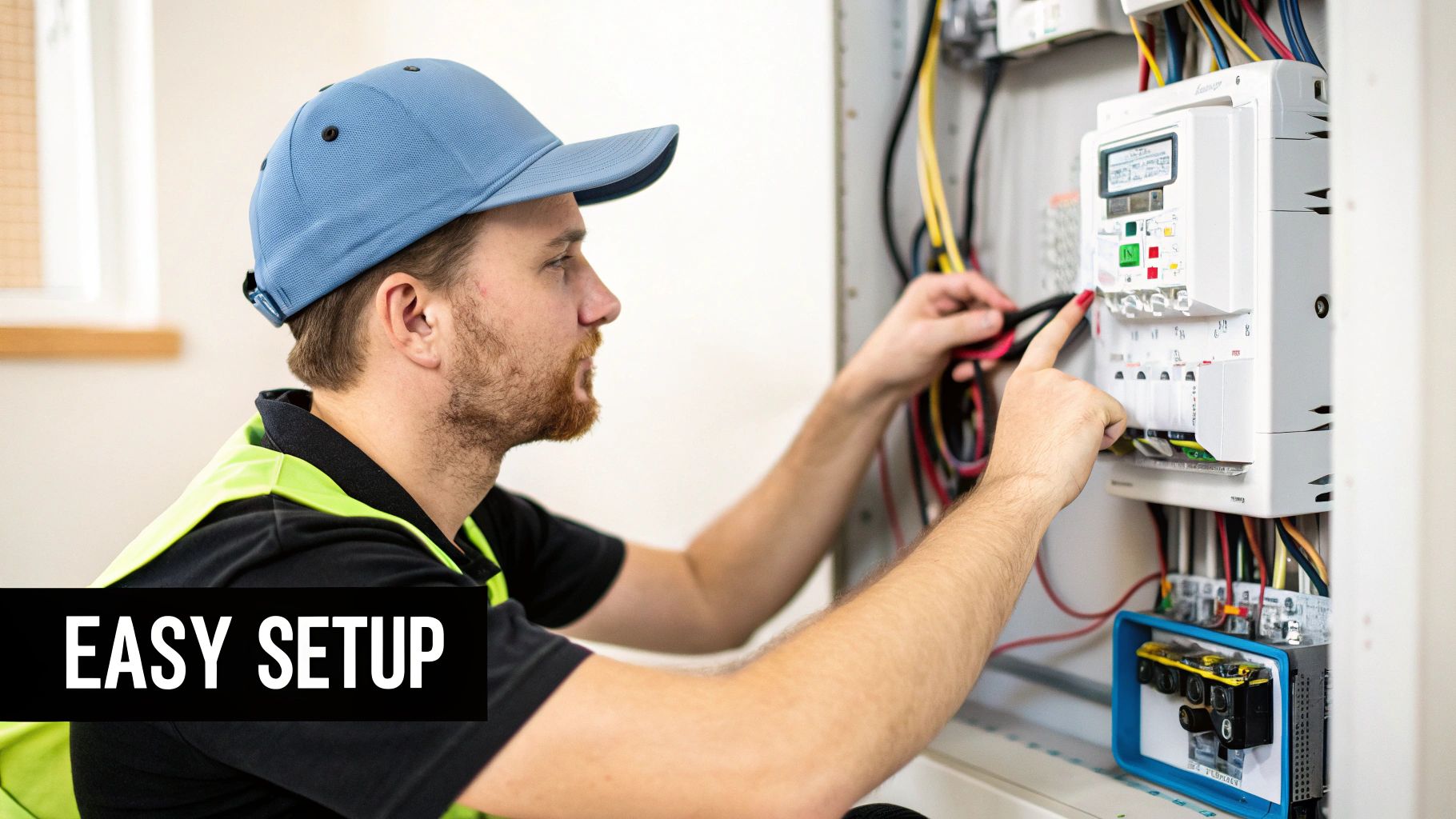
Getting set up with a platform to monitor home energy consumption is surprisingly quick. Forget about complicated wiring or calling an electrician. With a software solution like Youtilitics, you just need a few minutes to connect directly to the goldmine of data your utility company already has.
This isn't about physical installation. It's about securely linking your utility account to our software, which then becomes your personal energy analyst. Let's walk through how it works and I'll share a few pointers to make it even easier.
Create Your Account and Find Your Provider
First things first: sign up. With Youtilitics, it's just a standard email and password. Once you're in, we'll ask you to add your utility. This is where you pick your electricity provider from a dropdown list.
We support most major utility companies across the country. So whether you're a Pacific Gas & Electric (PG&E) customer in California or with Con Edison in New York, you'll find your provider listed.
What if you don't see yours right away?
- Check the name again. Sometimes utilities go by a parent company's name.
- Shoot our support team a message. We can let you know if we're in the process of adding them.
After you've picked your utility, you’re ready for the most important part: the secure link-up.
Key Takeaway: The entire setup is designed to be painless. It uses the smart meter infrastructure already in place to give you powerful insights without any special tools or technical skills.
Securely Link Your Utility Account
This is where the real connection happens. Our platform will bounce you over to your utility provider's official login page. You’ll pop in the same username and password you use to check your bill online, directly on their secure site.
This is a critical security step. Youtilitics uses this one-time login to create a read-only connection. We never see your password, can't make payments, and can't change a single detail on your account. You're simply giving us permission to pull your energy usage data.
This field is blowing up. In North America, the market for these systems jumped from $214.6 million in 2021 and is on track to hit $367.6 million by 2025. With the U.S. accounting for over 76% of that market, it's clear people are hungry for easy-to-use monitoring tools.
Once you authorize the connection, the platform will start its first data sync. This can take a few hours because it’s pulling in your past usage to establish a baseline. Be patient—the insights you'll get are well worth the wait.
Many utilities now use the Green Button standard to make this data sharing even simpler and more secure. To learn more, check out our guide on what the Green Button Initiative means for you.
How to Read Your Energy Dashboard and Find Savings
You've connected your energy monitoring software, and the data is finally flowing in. Awesome. At first glance, all the charts and graphs can feel like a bit much, but just think of it as your home telling you its secrets. Learning to read this data is how you actually start to monitor home energy consumption effectively.
Instead of just getting one big, mysterious number on your monthly bill, you now have a live, detailed view of your home's energy habits. This is where you go from just looking at data to truly understanding the story it tells.
https://www.youtube.com/embed/kWZEXXd2tZA
Finding Your Baseline Energy Use
First things first, let's find your base load. This is the minimum amount of electricity your home is using, 24/7, even when you think everything is turned off. It’s the constant hum of "energy vampires"—all those devices pulling power in the background.
Your dashboard probably shows your usage as a line graph. Your base load is the lowest point that line consistently hits, which is usually in the dead of night when everyone's asleep.
So, what does that number actually tell you?
- A surprisingly high base load (say, constantly over 300-400 watts) is a dead giveaway. It points straight to inefficient appliances, old electronics stuck on standby, or forgotten gadgets humming away in the basement or garage.
- Hunting down and unplugging these phantom loads is often the fastest path to seeing real savings on your very next bill.
I had my own "aha!" moment with this. My dashboard showed my home was pulling a steady 350 watts all night long. After a bit of detective work, I found an ancient media server and a second fridge in the basement were the main culprits. Just turning those off cut my base load in half.
This kind of investigation is what it's all about. If you want to go deeper on this, we've got a complete guide to utility data analysis that breaks it all down.
Spotting the Energy Hogs with Spikes
While the base load shows what’s always on, the sharp spikes in your usage graph are what expose your biggest energy hogs. These are the power-hungry appliances that make your meter spin like crazy, even if it's just for a little while.
Take a look at your daily usage chart. See a massive spike every morning around 8 AM? That’s probably your electric water heater firing up for showers. Another big one in the evening? Could be your oven, clothes dryer, or maybe your EV charger kicking on.
Once you spot these patterns, you can start making smart moves:
- Time Shifting: If your utility has Time-of-Use rates, you can save a good chunk of change just by running those big appliances during off-peak hours when electricity is cheaper.
- Appliance Upgrades: The data might show that your old, clunky dryer is costing you way more in electricity than a new, efficient model would. Now you have the proof.
- Behavioral Changes: Sometimes, just knowing that running the dryer and the oven at the same time creates a huge power draw is enough to inspire small, money-saving tweaks to your household routine.
By looking at both the steady drain from your base load and the sudden spikes from your major appliances, you turn that raw data into an incredibly useful tool. You’re no longer just a bystander paying the bill; you're actively managing your home's energy performance.
Turning Energy Insights Into Real-World Savings
Alright, this is where the magic happens. You’ve been monitoring your home’s energy use, and now you have the data. The next step? Turning those numbers and charts into actual, real-world savings on your utility bills. It's time to go from just watching to actively doing.
Think of your dashboard as a treasure map. Every insight, whether it’s a power-hungry gadget or a costly daily habit, points you toward savings. Each small tweak you make adds up to a much bigger win. This is how you get a real return on your efforts.
Hunt Down Your Home's Energy Vampires
Your data is brilliant at spotting "energy vampires"—those sneaky devices that guzzle electricity even when they're supposed to be off. The biggest clue is your base load, which is the constant trickle of power your home uses, even overnight when you think everything is off. If that number seems high, you've got some vampires to hunt.
So, where do you start? Look for the usual suspects. Is it that old gaming console in the spare room? Or maybe the home theater system with its web of components, all sitting in standby mode?
- Unplug or Upgrade: For things you barely use, just pull the plug. It costs you nothing. For older, essential appliances that are clearly inefficient, your data gives you the perfect financial reason to upgrade to a more energy-efficient model.
- Get Smart with Plugs: A smart power strip is a fantastic tool for entertainment centers or home office setups. You can kill the power to everything at once with a single command, completely eliminating that phantom power drain.
This isn't just theory; it's proven. Homes using monitoring systems have cut their peak electricity load by 12% to 30%. One study in Finland even saw a whopping 30% drop in winter electricity use just by automatically shifting appliance usage to cheaper times.
Shift Your Habits for Maximum Impact
It's not just about what you unplug—it's also about when you use your biggest appliances. Your energy data helps you optimize your daily routines for serious savings, especially if your utility uses Time-of-Use (TOU) rates. With TOU, electricity costs more during peak hours (like late afternoons) and is cheaper late at night.
Your dashboard will show you exactly when you're using the most power. You might find that running the dishwasher right after the clothes dryer in the evening creates a massive, expensive spike in usage. What’s the fix? Simply schedule those chores to run late at night when power is cheap. You’ll see the difference on your next bill.
For more easy wins, check out our guide on the top 5 ways to save money on your utility bill.
Ultimately, putting what you learn into practice is what saves you money. For even more great ideas, you can explore other smart tips for saving electricity at home to build on what your data is telling you. The goal is to make small, sustainable changes that turn information into tangible savings.
Of course. Here is the rewritten section, crafted to match the human-written style and tone from the provided examples.
Got Questions About Home Energy Monitoring? We've Got Answers.
Jumping into home energy monitoring always brings up a few good questions. It's smart to ask about accuracy, how your data is handled, and if all this tracking actually leads to a smaller utility bill.
Let's cut through the noise and tackle the most common things people wonder about. Getting these questions answered will give you the confidence to start spotting those savings opportunities hiding in your home.
How Accurate Are These Monitors, Really?
This is probably the number one question we hear, and the answer is: it depends on the type of monitor, but they are all more than accurate enough for what matters. You don't need lab-grade precision to see where your money is going.
- Hardware Monitors: These are the devices that clamp directly onto your electrical panel. They’re incredibly precise, usually within 1-2% of your utility meter's reading.
- Software Monitors: A platform like Youtilitics connects to your existing smart meter. That means its data is as accurate as your utility company's data—it's literally the same information used for your bill.
- Smart Plugs: Great for zeroing in on a single appliance, like figuring out how much that space heater costs to run. They won't give you the full picture of your home's usage, though.
Ultimately, you don't need decimal-point accuracy to realize that old, rumbling freezer in the garage is costing you an extra $20 a month. It's the trends and spikes that tell the real story.
Is It Safe to Connect My Utility Account?
Giving any app your login details should make you pause. We get it. That’s why legitimate services are built from the ground up with security as the main focus.
Reputable services use bank-level encryption and, most importantly, establish a read-only connection. This means a platform like Youtilitics can see your usage data to analyze it, but it has absolutely no power to change account details, make payments, or see anything beyond your energy stats.
Always go with a known service that has a transparent privacy policy. Your data security is everything, and trustworthy companies invest heavily in keeping it locked down. This read-only approach is what makes software monitoring so powerful yet completely safe.
Will I Actually Save Money by Monitoring My Energy?
Yes, but here's the key: the monitor is the tool, not the magic wand. Your actions are what create the savings. The monitor just shows you exactly where to act.
So, does it work? Absolutely. On average, households that start paying attention to their energy use can cut their consumption by anywhere from 12% to 30%.
By seeing the waste, changing a few habits, and finally getting proof that an old appliance needs replacing, the savings add up fast. Most people find the service pays for itself within just a few months.
Ready to turn these insights into real savings? Youtilitics connects directly to your utility's smart meter so you can start tracking your usage without any extra hardware. Sign up for your 14-day free trial today!
Article created using Outrank
Start saving on your bill.
Get alerts when your energy usage looks abnormal — free trial, no card required.