What Causes High Electricity Bills? Key Factors Explained
That feeling of dread when you rip open your electricity bill and see a number way higher than last month? We’ve all been there. It’s frustrating, and it’s easy to feel powerless.
But a shockingly high bill is rarely a total mystery. It’s usually a combination of a few key culprits working together behind the scenes. Think of your home's energy use like a slow leak—one tiny drop isn't a big deal, but hundreds of them add up to a serious problem over time.
This isn't just a feeling; it's a growing reality for many homeowners. Power is getting more expensive. In fact, average U.S. electricity prices have jumped 17% over the last three years, growing faster than the overall inflation rate of 13%. Utilities are scrambling to keep up with demand, especially during peak hours, and those infrastructure costs often get passed right down to us.
So, What’s Really Driving Up My Bill?
To figure out what’s happening in your home, you need to play detective. The good news is that most issues fall into just a few categories. Once you know where to look, you can move from guessing what’s wrong to knowing exactly where your money is going.
Your bill isn't just a number; it's a data story about your home's daily operations. Learning to read it is the first step toward rewriting the ending.
We'll break down the usual suspects behind a high bill, one by one. By the end, you'll know how to spot them in your own home. We'll be covering:
- Appliance and Device Usage: Pinpointing the "energy hogs" in your home, from the obvious (like your HVAC) to the sneaky ones you'd never suspect.
- Home Inefficiencies: Uncovering the hidden problems like air leaks or old insulation that force your systems to work overtime just to keep up.
- Behavioral and Rate Factors: Seeing how your family's daily routines and your utility's specific pricing plans can team up to inflate your costs.
Here's a quick overview of the main drivers that can send your bill soaring.
Primary Causes of High Electricity Bills at a Glance
This table breaks down the most common reasons your electricity costs might be unexpectedly high, giving you a starting point for your investigation.
| Category | Common Culprits | Impact Level on Bill |
|---|---|---|
| Appliance & Device Usage | HVAC systems, water heaters, old refrigerators/freezers, clothes dryers, pool pumps | High |
| Home Inefficiencies | Poor insulation, air leaks (windows/doors), inefficient windows, duct leaks | High |
| Behavioral & Rate Factors | Using power during peak-rate hours, "vampire" power drain, leaving lights on | Medium to High |
| External Factors | Rising utility rates, seasonal weather extremes, changes in household size | Medium |
By understanding these categories, you can start connecting the dots between your daily life and your monthly bill.
The first step is to get a clear, detailed picture of what's happening. The best way to do that is to see your consumption patterns laid out in black and white. Our guide on how to monitor home energy usage is the perfect place to start.
Identifying the Biggest Energy Hogs in Your Home
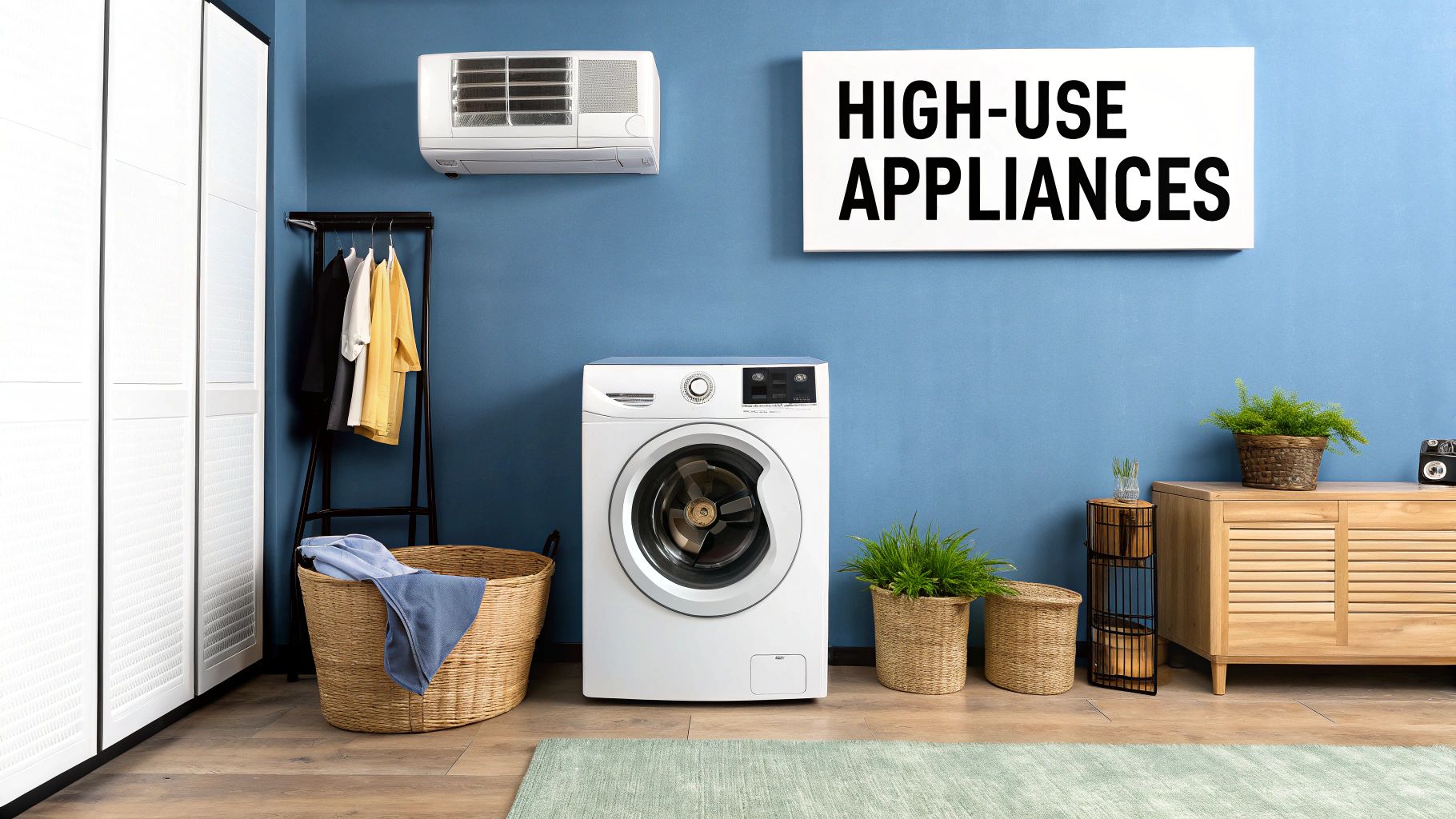
If you really want to get a handle on what’s causing your high electricity bills, you have to think like an energy detective. Some of the culprits are hiding in plain sight, while others are masters of disguise, quietly sipping power around the clock.
Let's shine a light on the biggest energy hogs that are almost certainly running up your costs. These aren't just using a little extra juice—they are the true heavyweights of home energy consumption.
The Obvious Powerhouses
Your HVAC system, which includes both heating and air conditioning, is nearly always the single biggest power user in any home. During a sweltering summer heatwave or a frigid winter cold snap, your system is working overtime just to keep your house comfortable.
For a large home, running the central air just eight hours a day can easily tack on $70 to $110 per month to your bill.
A malfunctioning air conditioner is a notorious offender. Getting it fixed with professional AC repair services doesn't just make you more comfortable; it makes the unit run efficiently, which can dramatically lower your bill. You can get a much deeper understanding of how to manage these costs by learning to optimize your HVAC usage with modern tools.
Hot on the heels of your HVAC are the other major appliances:
- Water Heater: It’s working 24/7 to keep a huge tank of water hot and ready for your next shower or load of dishes. That constant effort adds up.
- Refrigerator & Freezer: Just like your HVAC, these appliances are always fighting the room's temperature to stay cold. An old fridge, especially one made before 2000, could be costing you hundreds more per year than a new ENERGY STAR model.
- Clothes Dryer: The sheer amount of heat needed to dry a full load of laundry makes the electric dryer another top contender for your home's energy usage crown.
The Silent Cost of Vampire Power
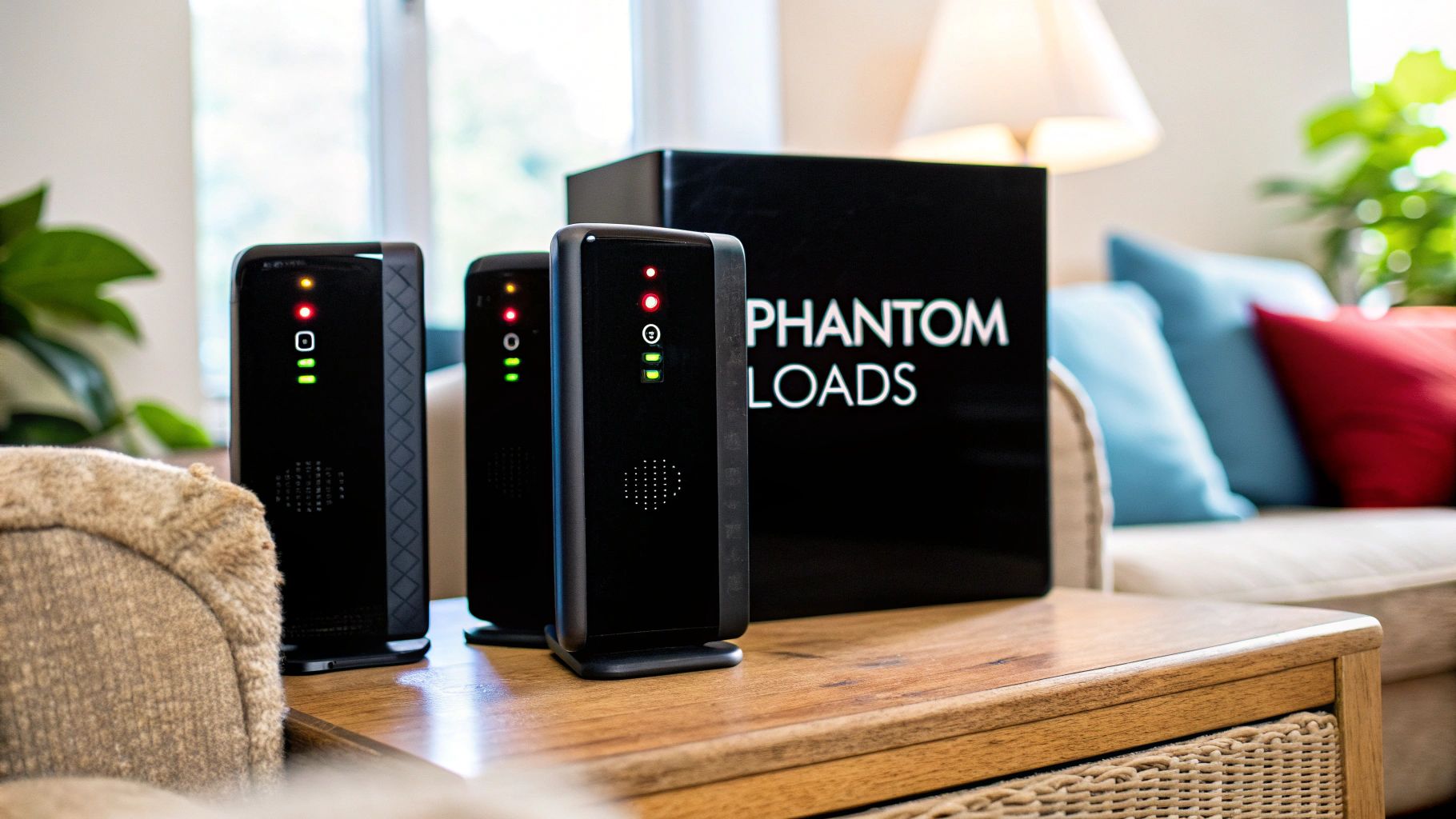
It's not just the big stuff. Your home is probably filled with "energy vampires"—devices that keep drawing power even when they're turned off or in standby mode. One device might not seem like much, but their combined thirst is a huge, often overlooked, reason for high electricity bills.
Research from Lawrence Berkeley National Laboratory found that this "vampire power" can account for as much as 10% of your total home electricity use.
Just think about all the electronics you own with a little clock, a glowing light, or a remote-control sensor. We're talking about your TV, coffee maker, microwave, gaming consoles, and all those chargers plugged into the wall. Each one sips a tiny bit of electricity, but together, they create a constant, wasteful drain.
Unplugging them or using a smart power strip is a surprisingly effective way to slay these vampires. It’s a simple way to cut down on this hidden cost and make your home more efficient, one outlet at a time.
How Your Home's Structure Wastes Energy
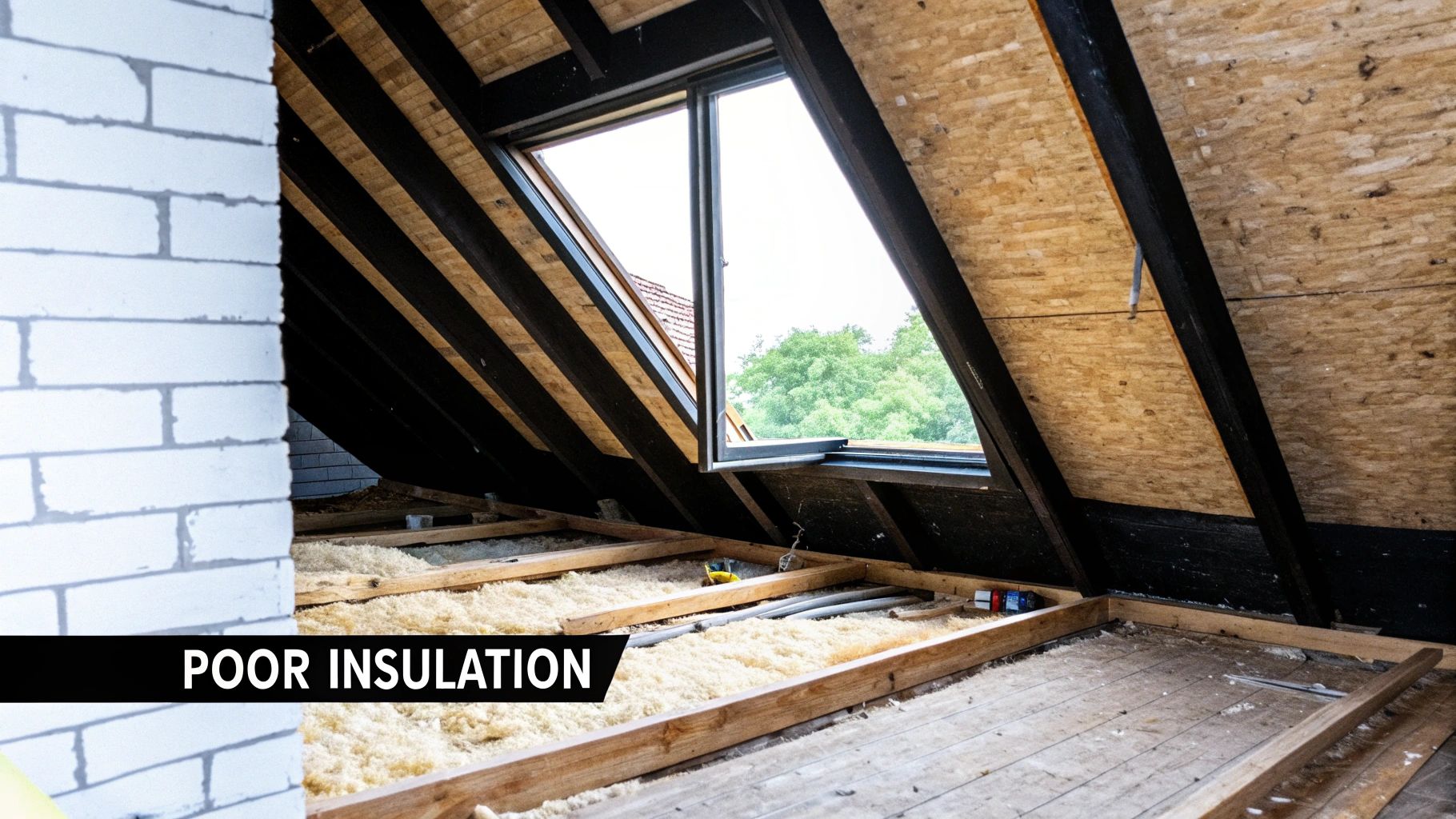
We all know that big, energy-hungry appliances can send bills soaring. But there’s a much quieter culprit that could be draining your wallet: the physical structure of your home. If your house is constantly leaking conditioned air, your heating and cooling systems have to run nonstop just to keep the temperature stable.
Think of it like wearing a winter jacket full of holes. It doesn't matter how warm you are; the cold air will always find a way in. A house with poor insulation and tiny air leaks is in a constant, losing battle with the weather outside, and you’re the one paying for it.
The Hidden Costs of Poor Insulation
Insulation is the thermal barrier that separates your cozy living space from the outside world. It’s what keeps your home cool in the summer and warm in the winter. But when that insulation is old, settled, or just not thick enough—especially in the attic and walls—heat moves in and out far too easily.
On a hot summer day, a poorly insulated attic can become an oven, radiating heat down into your living space and forcing your AC to work overtime. In the winter, the reverse happens as all that expensive heat you're paying for rises and escapes right through the ceiling. This invisible energy transfer is a huge drain on your finances.
Industry experts estimate that improving insulation and sealing air leaks can cut heating and cooling costs by an average of 15%. For some homes, those savings are even higher.
Pinpointing Invisible Air Leaks
Beyond insulation, you have to worry about the small cracks and gaps all over your home that create drafts and kill your energy efficiency. They show up in predictable places, and while they seem small, they add up to a massive problem.
You can even do a quick DIY audit to find them. On a windy day, light an incense stick and hold it near common problem spots. If the smoke flickers or blows sideways, you’ve found an air leak.
Common Air Leak Locations:
- Windows and Doors: Check the frames and seals for drafts or any gaps you can see.
- Electrical Outlets and Switch Plates: Air loves to sneak through the small openings around electrical boxes on your exterior walls.
- Attic Hatches: A leaky attic hatch is like leaving a window cracked open 24/7.
- Plumbing and Ductwork Penetrations: Gaps where pipes and ducts go through walls or floors are major offenders.
Sealing these leaks with caulk, weatherstripping, or foam gaskets is one of the most cost-effective fixes you can make. It’s not just about turning off a light; it’s about fixing the root cause of your high energy bills. If you want to dive deeper into how building materials and design impact your usage, check out this complete guide to energy efficiency for buildings.
By making your home’s "jacket" airtight, you let your HVAC system finally do its job properly instead of running constantly to make up for structural problems.
Making Sense of Your Utility Bill and Rate Plans
Getting a high utility bill can feel like a punch to the gut. What's worse, the bill itself is often a confusing mess of jargon and numbers that seems designed to be ignored. But learning to read this document is the first real step toward figuring out what’s driving up your electricity costs.
Your bill isn't just one big number. It's broken down into smaller pieces. You’ll always see a base charge—a flat fee you pay just to be connected to the grid. Then you have your actual usage, measured in kilowatt-hours (kWh). This is the most important number because it shows exactly how much power your home consumed.
Understanding Your Rate Plan
Beyond just how much electricity you use, when you use it can make all the difference. This is all thanks to your utility’s rate plan. Many providers now use tiered rates or, more commonly, Time-of-Use (TOU) plans.
Think of it like surge pricing for electricity.
Time-of-Use pricing means the cost of electricity changes throughout the day. Power costs the most during "peak hours"—usually late afternoons and early evenings when everyone gets home from work and school—and is cheapest during "off-peak" hours, like late at night.
This is exactly why running your dishwasher at 6 p.m. can cost you way more than running it at 10 p.m., even though the machine is doing the exact same amount of work. If your daily habits don't line up with your rate plan, you could be accidentally doubling your costs.
How Global Factors Affect Your Local Bill
The price you pay isn’t just decided by your local utility company, either. It’s also tied to bigger economic and geopolitical trends. Things like the global cost of natural gas or a country's energy policies have a direct impact.
Just look at Germany, which has some of the highest electricity costs in the world. German households pay around $0.365 per kWh. That price nearly doubled after the country decided to phase out nuclear power, making them more dependent on other, more expensive energy sources. You can see how different countries stack up by exploring global electricity prices and their causes.
Once you understand your own usage habits and the rate plan you're on, you can start making smarter moves. Shifting your big energy-guzzlers—like laundry, EV charging, or running the dishwasher—to off-peak hours is one of the easiest ways to see a real drop in your bill. It’s not about using less energy, it’s about using it at the right time.
Uncovering Your Home's Specific Energy Problems
Knowing the general causes of a high electricity bill is a good first step, but real savings come from finding the specific culprits inside your own four walls. It’s time to stop guessing and start diagnosing what makes your home’s energy profile unique. Think of it as becoming a detective for your own house.
The investigation starts with your own usage data. Many utilities now give you access to your smart meter data, which can tell a surprisingly detailed story about your daily habits. Are you seeing weird energy spikes in the middle of the night? Is your weekend usage consistently higher than you realized? This data is your first big clue.
Next, it’s time for a room-by-room walkthrough to hunt for phantom loads, also known as vampire power. These are the sneaky devices that sip electricity even when they’re “off”—anything with a standby light, a clock, or an instant-on feature is a potential suspect.
Performing a Simple Home Audit
You don't need to be a professional to start spotting problems. A basic home energy audit can uncover the biggest offenders behind your high bills. It’s all about systematically checking different areas of your home for both obvious and hidden energy waste.
For a more detailed walkthrough geared toward your specific utility, you can learn more by checking out our guide on how to perform a PG&E home energy audit.
Here’s a quick checklist to get you started:
- Appliance Assessment: Check the age and condition of your major appliances. That old refrigerator in the garage or an inefficient dishwasher could easily be costing you hundreds of dollars every year.
- Phantom Load Hunt: Use a smart plug to measure just how much power your TV, game consoles, and coffee makers are drawing on standby. You might be shocked at what they contribute to your baseline energy use.
- Lighting Review: Go room by room and do a quick count of how many old-school incandescent or halogen bulbs are still hanging around. Swapping them for LEDs is a quick win that can cut your lighting costs by up to 75%.
To help you get organized, we've put together a simple checklist. Think of this as your field guide for your home energy investigation. Just go through your home, area by area, and see what you find.
Your Home Energy Audit Checklist
| Area/Appliance | Check For | Potential Solution |
|---|---|---|
| Living Room | TVs, game consoles, stereos on standby | Use a smart power strip to turn everything off at once. |
| Kitchen | Refrigerator age and seal tightness | Clean coils; check for a tight seal with a dollar bill. |
| Small appliances (coffee maker, microwave) | Unplug when not in use or use a power strip. | |
| Bedrooms | Phone/device chargers left plugged in | Unplug chargers once devices are full. |
| Laundry Room | Dryer vent blockage | Clean the vent and lint trap regularly for efficiency. |
| Using hot water for every wash | Switch to cold water cycles whenever possible. | |
| Lighting | Incandescent or halogen bulbs | Replace with energy-efficient LED bulbs. |
| HVAC System | Dirty air filters | Replace filters every 1-3 months. |
| Thermostat settings (especially when away) | Install a smart thermostat to automate setbacks. | |
| Windows & Doors | Drafts and air leaks | Apply weatherstripping or caulk to seal gaps. |
By taking a systematic approach, you can quickly build a list of actionable items that will make a real difference.
Automating Your Energy Analysis
Let's be honest—manually tracking all of this can be a real chore. This is where modern energy monitoring tools come in and do the heavy lifting for you. Platforms like Youtilitics make the process automatic, connecting directly to your utility data to give you insights that are personalized to your home.
Below is an example of how a platform can break down your home's energy usage, turning complex data into something you can understand at a glance.
This dashboard immediately shows your hourly consumption, helping you pinpoint exactly when those costly energy spikes are happening. By translating raw numbers into clear graphs, you can see the direct impact of running your AC or charging your EV, letting you make smarter decisions without any of the guesswork.
When you combine a hands-on audit with automated analysis, you go from wondering what’s causing your high bill to knowing precisely what’s happening in your home and how to fix it. This targeted approach ensures your efforts are focused where they’ll make the biggest dent in your monthly statement.
Common Questions About High Electric Bills
Even after you’ve hunted down the big culprits, a few nagging questions about your power bill might still be rattling around in your head. Let's clear the air and tackle some of the most common ones people have.
Why Is My Bill So High in the Summer?
If your summer bill gives you sticker shock, you can almost always point a finger at one thing: air conditioning. Your AC is a beast, and it's easily the single biggest power hog in your home. When the temperatures outside start climbing, your unit has to run harder and longer just to keep things comfortable inside. It's a simple, direct relationship.
On top of that, other appliances like your refrigerator and freezer are also working overtime to fight the ambient heat and keep their cool. This double whammy of high usage often hits right during your utility's peak rate hours, which just pours salt in the wound and makes a high bill even higher.
Can a Faulty Meter Cause a High Bill?
It's possible, but extremely unlikely. Modern smart meters are incredibly accurate and go through a ton of testing. Before you jump to blaming the meter, it’s far more likely that the high bill is coming from something else.
Think about it:
- Did you recently get a new, power-hungry appliance?
- Have your daily habits changed, or has someone new moved in?
- Are there hidden problems, like air leaks around windows or old, packed-down insulation?
There's a really simple way to check. Go to your circuit breaker and switch everything off. If your meter still shows you're using power, that's when it's time to pick up the phone and call your utility company.
This straightforward process helps you systematically find the real source of your high bills.
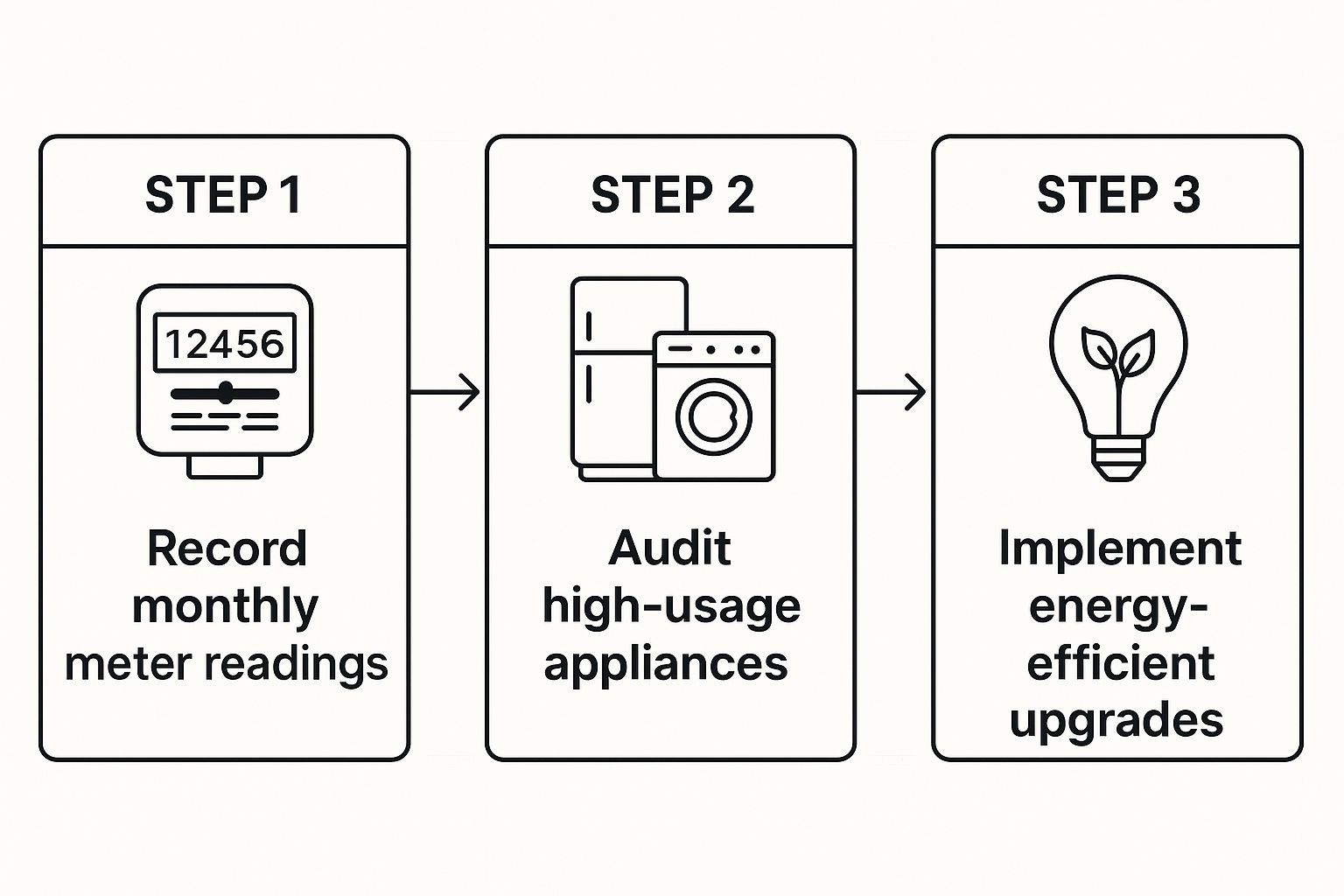
By following these steps, you can go from just looking at your meter to auditing specific appliances and making upgrades that actually work.
Does Unplugging Appliances Really Save Money?
Yes, it absolutely does. A lot of people don't realize that many of their electronics are sipping power even when they're "off." This is often called "phantom power" or vampire load.
Your TV, gaming consoles, and phone chargers are all guilty. Together, they can quietly add up, accounting for 5-10% of your total energy use. The easiest fix is to plug them into a power strip and flick the switch off when you're done. It's a small change in habit that delivers real savings.
Once you get a handle on what’s driving your bill up, you can start looking at bigger solutions. To get a sense of the long-term savings, you could even play around with a solar panel calculator.
Ready to stop guessing and start knowing exactly where your energy dollars are going? Youtilitics connects to your utility data to give you personalized insights without any hardware. Start your 14-day free trial and see how easy it is to lower your bills.
Article created using Outrank
Start saving on your bill.
Get alerts when your energy usage looks abnormal — free trial, no card required.