Monitor Home Energy Usage to Lower Your Bills
To really get a grip on your home energy usage, you first need to see what's happening behind the scenes. This means getting your hands on your consumption data, either by connecting to your utility company's data feed or by installing some simple hardware. The whole point is to turn those raw numbers into something you can actually use—to see exactly where and when your energy dollars are being spent.
Why You Should Monitor Your Home Energy Usage

We’ve all been there. You open the electricity bill and your jaw drops. It leaves you wondering what on earth happened. Was it the A/C running nonstop during that heatwave? The new gaming console? This is exactly the kind of frustrating guesswork that proactive energy monitoring eliminates. It flips the script, moving you from reacting to a high bill to preventing one in the first place.
Instead of guessing, you get clear, data-driven answers. Think of it like a financial advisor, but for your electricity. It shines a light on "energy vampires"—those sneaky devices that constantly sip power, even when they’re supposedly off. You can finally see the real-world cost of leaving your entertainment center on standby or running that ancient freezer in the garage.
The real win here is empowerment. When you see exactly where your energy is going in near real-time, you get the power to make smart changes that directly shrink your monthly bill.
This is about more than just saving a few bucks, though. It’s also about doing your part. Homes account for a huge slice of global electricity demand. It's no surprise that the home energy management market is expected to balloon from USD 5.8 billion to USD 21.7 billion by 2034. This reflects a massive global push for better efficiency, and you can be a part of it. If you're curious, you can explore the research behind home energy management trends and see how individual actions add up.
The cool part is that you'll start seeing the benefits almost right away, but they also build up over time, leading to some serious long-term savings and smarter habits.
Immediate vs Long-Term Benefits of Energy Monitoring
Let's break down what you can expect to see, both in the first month and down the road. The immediate wins are satisfying, but the long-term changes are where the real value lies.
| Benefit | Immediate Impact (First 30 Days) | Long-Term Impact (6+ Months) |
|---|---|---|
| Financial Savings | Identify and unplug major energy vampires for quick bill reductions. | Optimize HVAC schedules and shift appliance usage for sustained 5-15% savings. |
| Appliance Insights | Pinpoint which specific devices are the biggest energy hogs. | Detect failing or inefficient appliances before they break down completely. |
| Behavioral Change | Gain awareness of daily habits that contribute to high energy spikes. | Develop a more efficient household routine that becomes second nature. |
| Environmental Impact | Reduce your home's carbon footprint through initial, simple adjustments. | Make lasting lifestyle changes that significantly lower your overall energy waste. |
As you can see, what starts as finding a few easy wins quickly evolves into a more intuitive, energy-conscious lifestyle that pays dividends for months and years to come.
Choosing the Right Energy Monitoring Approach
Before you can start optimizing your energy use, you need to decide how you're going to get the data. There’s no single "best" way to do this; the right method really depends on your goals, your budget, and even your home. A renter trying to pinpoint a power-hungry appliance has very different needs than a homeowner juggling solar panels and an EV charger.
Let's walk through the three main ways you can get this data. Each one offers a different level of detail, cost, and effort.
Utility Provider Portals and Software
The easiest and cheapest place to start is with the tools your utility company already gives you. Most of them have a free online portal where you can see your past energy use, often broken down by the month, day, or even by the hour. It’s a great, no-cost way to get your feet wet.
But manually logging into a clunky utility website is a pain. This is where a service like Youtilitics comes in. It connects securely to your utility account to pull all that data automatically. Instead of you doing the work, the service grabs your usage info, puts it into clean dashboards, and sends you alerts when something looks off. It's the perfect "set it and forget it" option if you don't want to mess with installing any hardware.
Whole-House Energy Monitors
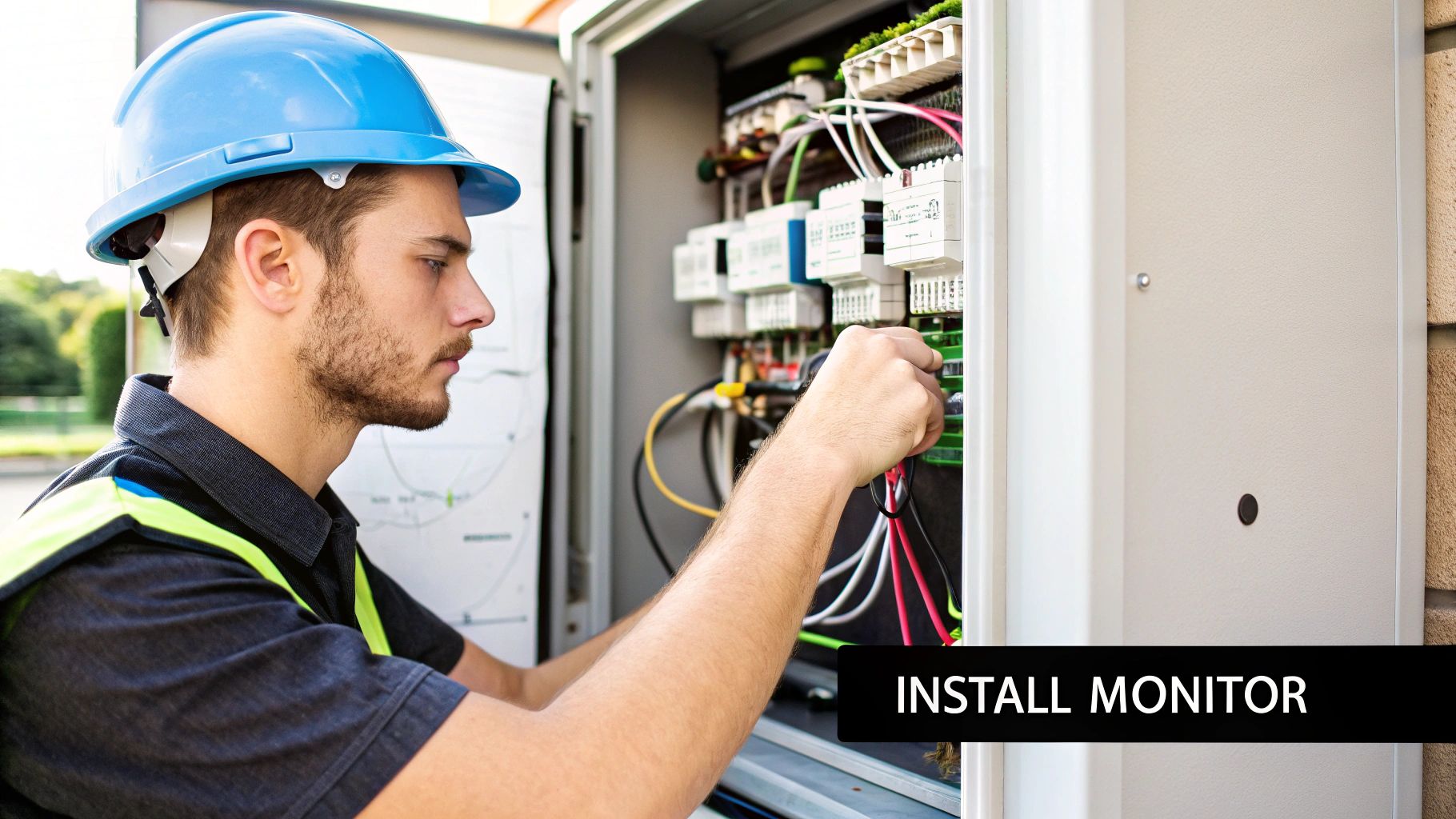
If you want a live, real-time look at your home's total electricity consumption, a whole-house monitor is the way to go. These devices use sensors that clamp directly onto the main wires in your breaker box, giving you a constant feed of your power draw.
This approach is fantastic for seeing the big picture. You can finally figure out your home's "always-on" energy baseline—all those little things drawing power in standby mode. You can also see the immediate impact of firing up the air conditioner or starting a load of laundry.
A whole-house monitor is perfect for homeowners who want to understand system-wide patterns, like how solar generation offsets usage or when EV charging has the biggest impact.
Device-Level Smart Plugs
What if you just want to know how much that ancient mini-fridge in the garage is costing you each month? For that, you need smart plugs. They're simple, pretty cheap, and you just plug them into an outlet and then plug your appliance into them.
Because there's no permanent installation, they're ideal for renters or for playing detective with specific gadgets. You can use them to:
- Find "Energy Vampires": Uncover the standby power consumption of your TV and sound system.
- Compare Old vs. New: See if that new air fryer is actually more efficient than your old toaster oven.
- Pinpoint Specific Costs: Get a precise number for how much electricity your gaming PC or space heater uses in a week.
Of course, the best strategy often involves a mix of these methods. You could start with your utility data through Youtilitics, add a whole-house monitor to see the overall flow, and then use smart plugs to investigate the individual devices that are driving up your bill. This layered approach gives you a complete toolkit to truly understand and control your home's energy use.
How to Access and Automate Your Energy Data
Getting your hands on useful energy data is a lot easier than you might think. You don't need to be a tech wizard or an electrician to make this happen. The whole point is to set up a system that feeds you information automatically, so you can monitor your home energy use without having to read a meter or mess with a clunky website.
The most hands-off way to do this is by connecting directly to your utility provider's data stream. Modern platforms, including our own Youtilitics, are built to handle all the heavy lifting. The setup is surprisingly simple: you just find your utility company in a list, put in your account info, and authorize a secure connection.
Once you’re linked up, the platform automatically pulls in your usage history and keeps syncing new data as it comes in. This is a game-changer. Within minutes, you can have a dashboard filled with months—or even years—of your past energy consumption, all without touching a single piece of hardware.
Many platforms also tap into data from the Green Button initiative. This is just a standard that gives you secure access to your own energy info. You can learn more about how Green Button works and check if your utility is on board.
Connecting Hardware Monitors and Plugs
What if you've gone with a whole-house hardware monitor? The initial setup is a bit more involved, but it's still very manageable. These monitors usually come with clamp-on sensors that you'll attach to the main electrical wires inside your home's breaker panel. It sounds a little intimidating, but the manufacturers give you detailed instructions, and you won't be cutting any wires.
Safety First: Always shut off the main breaker before you open your electrical panel. If you're even a little unsure about working inside the panel, it's always smarter to call a licensed electrician.
For smart plugs, it's about as easy as it gets. It’s a true plug-and-play experience. You just plug it into the wall, plug your appliance into it, and then connect the plug to your Wi-Fi using its app. Right away, you can see exactly how much power that specific device is pulling in real-time.
This infographic breaks down how all these data streams turn into real insights, from your smart meter right to your screen.
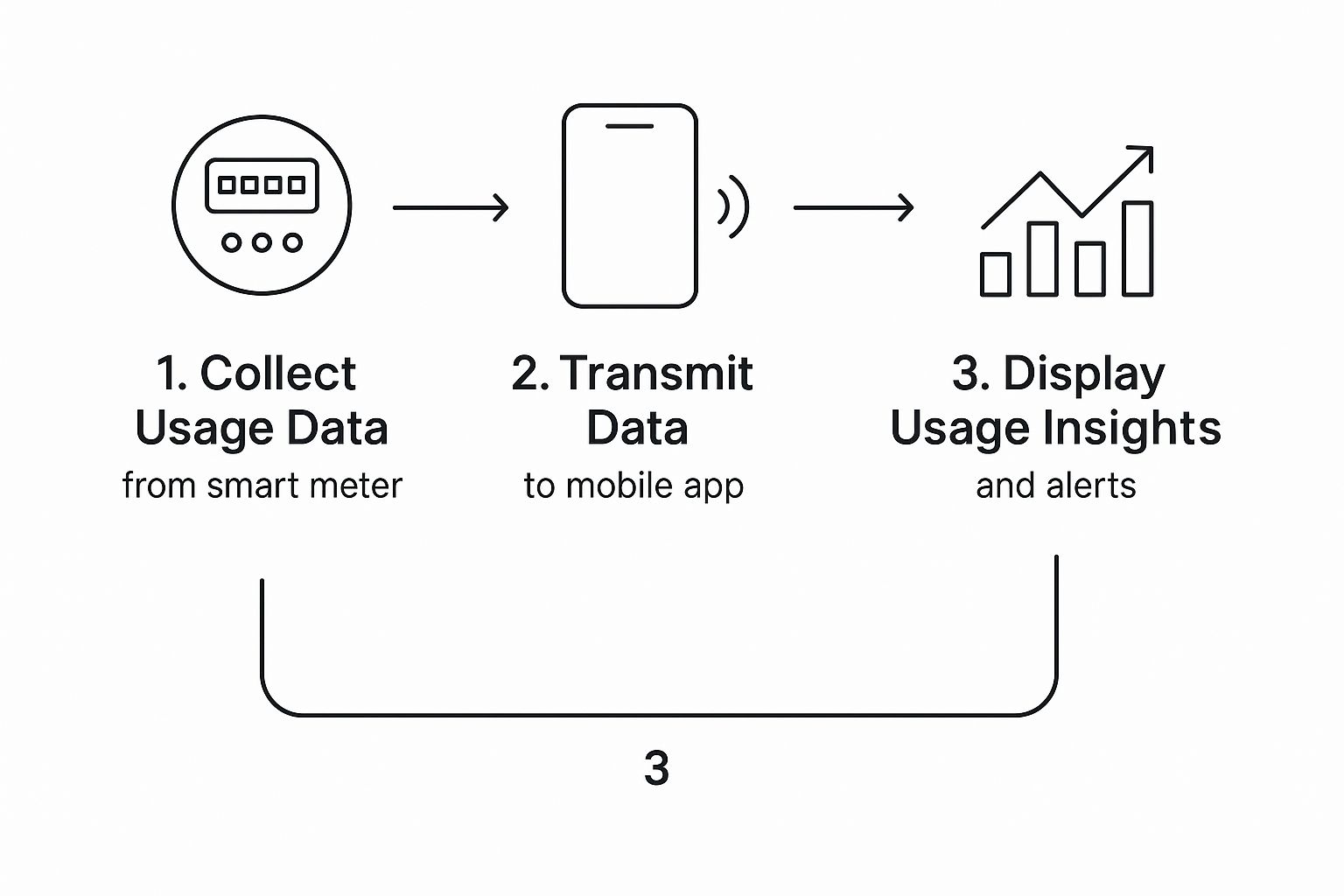
The key here is the smooth flow of information. It's what empowers you to see alerts and understand your consumption patterns instantly. No matter which path you take—a software connection, a whole-house monitor, or a few smart plugs—the goal is the same: create a reliable, automated data feed.
This steady stream of information is the foundation for everything else. It’s how you’ll spot inefficiencies, change your habits, and ultimately, bring those energy bills down.
Making Sense of Your Energy Consumption Data
 Once your energy data starts flowing into your monitoring software, you have what you need to start cutting your bills. But let's be honest—a screen full of charts and numbers can look a little overwhelming at first. The trick is to learn how to read the story your home's energy use is telling you, hour by hour.
Your first goal is to spot your home's daily rhythm. You’ll quickly see patterns emerge, like the predictable spike when everyone gets up and starts the coffee maker, or the slow, steady climb as the lights come on in the evening. This gives you a baseline for what a "normal" day looks like. Anything that deviates from that pattern will stick out like a sore thumb.
A sudden, sharp peak in the middle of the night when your daily graph is usually flat? That's an immediate red flag. It’s a signal that something is off, like a sump pump that won't shut off or a faulty appliance that needs your attention.
Understanding these daily patterns is the first step. Next, it’s time to figure out what’s actually driving the costs behind them.
Identifying Your Biggest Energy Hogs
Every home has what we call a vampire load or baseline consumption. This is the energy your house uses 24/7, even when you think everything is off. It's the combined pull from all those little things: clocks, TVs in standby mode, and smart speakers. Pinpointing this number gives you a fantastic starting point for some quick savings.
From there, you can hunt down the major appliances causing the biggest spikes. Not sure what's what? Try this simple experiment:
- Check your real-time usage: Make a note of the current power draw.
- Turn on a big appliance: Switch on your central air conditioning, electric oven, or clothes dryer.
- Check the data again: Watch how much your energy consumption jumps. That increase is exactly what it costs to run that device.
This quick test takes all the guesswork out of it. You'll see right away which appliances are the real energy hogs and where your money is actually going. A deeper dive into utility data analysis can uncover even more granular details, helping you fine-tune your savings strategy.
This ability for homeowners to get such detailed insights is a huge reason the global Home Energy Management System (HEMS) market is set to grow from USD 3.76 billion to USD 14 billion by 2033. These systems make it easier than ever to optimize usage by integrating everything from your thermostat to your monitoring software. You can read more about the HEMS market growth and what's driving it.
Turning Your Insights Into Real Savings
Having all this data is one thing, but translating that knowledge into a lower utility bill is where the magic really happens. Once you can see your home's unique energy rhythms, you can start making targeted, meaningful changes. This is the moment you connect the dots between the graphs on your screen and the money in your wallet.
For instance, do your overnight usage graphs show a consistent, low-level power draw that never quite hits zero? That's a textbook case of vampire load. Your mission, should you choose to accept it, is to hunt down those sneaky devices sipping energy while you sleep. Think entertainment centers, computer peripherals, and old chargers. Unplugging them or putting them on a smart power strip can lead to immediate, satisfying savings.
Or maybe your data clearly points to the HVAC system as the main energy hog in your home. Now you can get strategic. Experiment with bumping the thermostat up or down by just a degree or two. You can also set schedules to pre-cool or pre-heat your home right before you get back, avoiding those long, expensive cycles trying to change the temperature from scratch.
Advanced Money-Saving Tactics
Once you've handled the low-hanging fruit, it's time to get a bit more sophisticated. A powerful strategy here is load shifting.
The concept is simple: run your high-energy appliances during off-peak hours when electricity costs less. Your monitoring data will show you exactly when your utility's peak demand (and most expensive) times are. A common example is setting your dishwasher, washing machine, or pool pump to run late at night.
This has become even more important with the rise of electric vehicles. A home energy management system is your best friend here, intelligently scheduling when your car charges to take advantage of the cheapest rates.
The goal is to shift as much flexible consumption as you can away from expensive peak hours. This one habit can have a massive impact on your monthly bill, often without you even noticing a change in your lifestyle.
I've put together a quick table to show how different actions stack up. Some are easy wins, while others require a bit more effort, but they all contribute to a smaller bill.
Actionable Energy Saving Strategies
| Action | Difficulty | Potential Monthly Savings |
|---|---|---|
| Unplug Vampire Devices | Easy | $5 - $15 |
| Optimize Thermostat | Easy | $10 - $25 |
| Shift Appliance Use | Medium | $15 - $30 |
| Install Smart Thermostat | Medium | $20 - $40 |
| Upgrade to LED Lighting | Easy | $5 - $10 |
| Schedule EV Charging | Easy | $30 - $50+ |
As you can see, even small adjustments add up quickly over a month.
To really dial in your savings, try pairing your real-time data with a forward-looking tool. An energy bill forecaster can help you project future costs based on the new habits you're building. It's a powerful one-two punch for getting your spending under control.
And if you’re looking for more ideas, don’t forget to check out our guide on the top 5 ways to save money on your utility bill.
Answering Your Top Questions About Home Energy Monitoring
Getting started with home energy monitoring always brings up a few good questions. It's a new field for a lot of people, so it's only natural to want to know what you're getting into. We've heard them all, so we put together the most common ones to give you the straight answers.
This should clear up any confusion and get you ready to start tracking with confidence.
How Accurate Is This Stuff, Really?
Most of today's whole-house monitors are impressively accurate, usually landing within 1-2% of what your utility’s official meter says. Think of it less like a billing instrument and more like a speedometer for your electricity. It’s perfect for seeing what’s happening right now and catching those expensive energy spikes as they happen.
Smart plugs give you that same kind of reliability but for one device at a time. Their real magic isn't about chasing decimal points; it's about clearly showing you that the old mini-fridge in the garage is a bigger power hog than your new TV. The goal is spotting the big offenders, not getting lost in fractions of a kilowatt-hour.
Can I Monitor Energy Use If I Live In an Apartment?
You absolutely can. While you probably can't wire a whole-house monitor directly into the building's breaker box, you've still got great options for keeping tabs on your usage. Your utility provider’s own online portal is a fantastic place to start—no hardware needed, and it gives you a solid overview of your consumption trends.
For renters, smart plugs are your best friend. They need zero installation and are perfect for pinpointing the energy draw of specific devices like a gaming PC, a portable AC unit, or your entire work-from-home setup.
How Much Money Can I Actually Save?
This is the million-dollar question. While it's different for everyone, most people who actively watch their usage and make adjustments see savings between 5% and 15% on their monthly electricity bills. Honestly, the biggest wins usually come from finding and fixing just one or two problems you never knew you had.
Maybe you'll discover that an ancient freezer in the basement is quietly adding $20 a month to your bill. Or you might find that a badly programmed smart thermostat is running the heat when nobody's home. It’s all about using real data to make small, smart changes that add up to big savings over the year.
Ready to turn these ideas into real savings? Youtilitics plugs directly into your utility's data to automate tracking, spot waste, and send you alerts when it matters—no extra hardware to buy or install. Start your 14-day free trial today.
Article created using Outrank
Start saving on your bill.
Get alerts when your energy usage looks abnormal — free trial, no card required.